The market for commercial robotics has exploded in recent years. For facility managers and business owners, this presents a new challenge: "analysis paralysis." With dozens of models promising to revolutionize your maintenance workflow, how do you distinguish a high-performing industrial tool from a glorified gadget? Investing in an autonomous floor cleaning robot is a significant capital decision, and the difference between a successful deployment and a failed experiment often lies in the hardware specifications and software capabilities.
This guide moves beyond the marketing buzzwords to analyze the critical technical features you must compare. Whether you are outfitting a warehouse, a shopping mall, or a hospital, evaluating these specific criteria will ensure you select a machine that delivers real operational value.
1. Navigation Technology: The "Sensor Fusion" Standard
The first and most critical point of comparison is the navigation system. If the robot cannot navigate your facility reliably, its cleaning ability is irrelevant.
● Avoid Single-Sensor Systems: Early generations relied solely on 2D LiDAR or simple bumpers. These often struggle in dynamic environments with changing light conditions, or moving people.
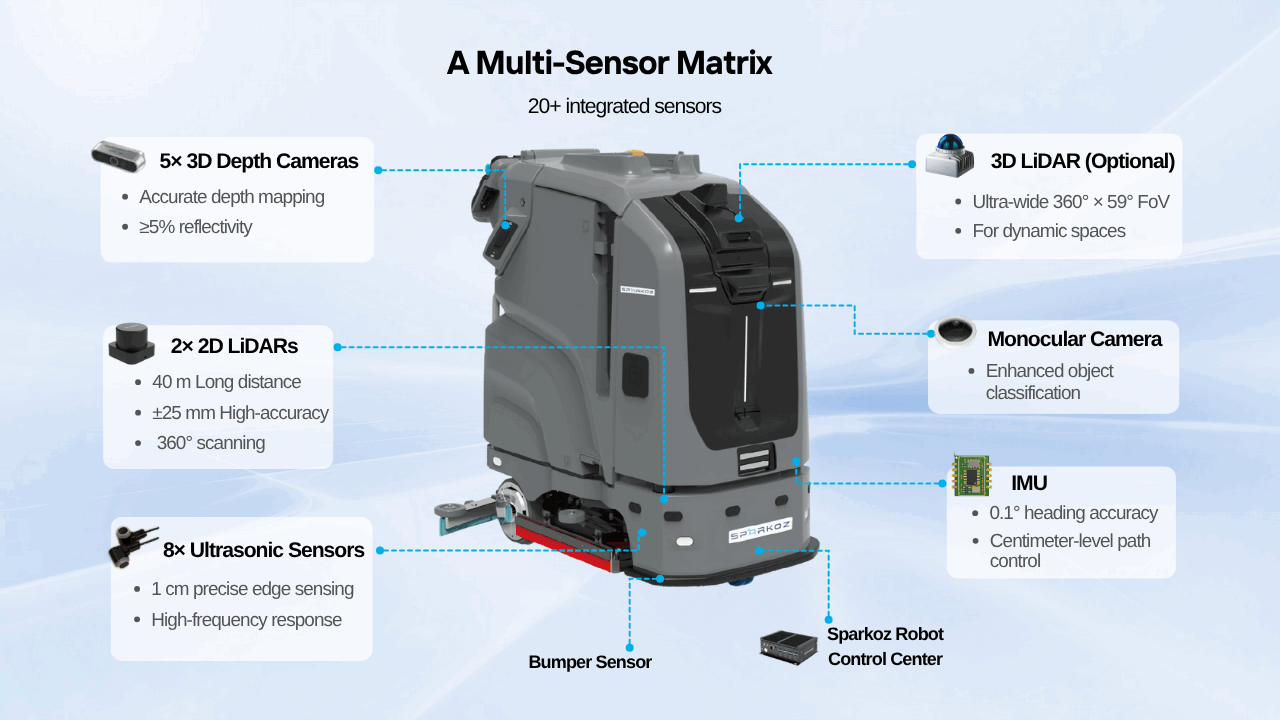
● Look for "Sensor Fusion": The industry standard for a top-tier autonomous floor cleaning robot is now multi-sensor fusion. This combines LiDAR (for long-range structural mapping) with Visual SLAM (cameras for object recognition) and 3D Depth Sensors (for detecting low obstacles like pallets).
● The "Lost" Test: Ask potential vendors about their relocalization capabilities. If a robot is moved manually or loses its signal, how quickly can it figure out where it is? Advanced systems like the Sparkoz TN70-Pro use sophisticated algorithms to re-orient themselves without needing to restart the map.
2. Cleaning Mechanism and Versatility
Don't assume all scrubbers clean the same way. The mechanical design of the brush deck dictates what kind of floors the robot can handle.
● Disc vs. Cylindrical Brushes: Disc brushes are generally better for deep scrubbing on flat surfaces (like tiled mall floors) and maintaining a high shine. Cylindrical brushes are superior for uneven surfaces (like grouted tile or concrete) and can often sweep up small debris while scrubbing. Some advanced platforms offer swappable decks.
● Edge Cleaning Capability: A common weakness in robotics is the "dead zone" near walls. Compare the "edge-to-edge" specification. A high-performing robot should be able to clean within centimeters of a wall or shelf.
● Multi-Mode Functionality: Can the robot do more than just scrub? The ability to switch modes—such as "Vacuum Only" for spills, or "Dust Wiping" for quiet daytime maintenance—adds tremendous value. This versatility is essential when selecting the right floor cleaning robot.
Check the video about Sparkoz TN70-Pro Cylindrical Brush Version

3. Autonomy Metrics: Battery and Tank Capacity
True autonomy is defined by how long the robot can work without human assistance. This is a math game involving battery life, water usage, and tank size.
● Run Time vs. Charge Time: Look for Li-ion batteries that offer at least 3-4 hours of continuous scrubbing. Equally important is the charging speed. Fast-charging capabilities can double a robot's daily productivity.
● Tank Ratio: A large battery is useless if the water tank runs dry in 30 minutes. Compare the clean water and sewage tank capacities (e.g., 70L/50L).
● Breakpoint Continuation: This is a vital software feature to look for when you compare commercial cleaning robots. If the robot runs low on power or water mid-task, does it just stop? A smart system will return to its station, recharge/refill, and then automatically return to the exact spot it left off to finish the job.
4. Usability and Software Ecosystem
The hardware might be impressive, but if the software is difficult to use, your staff won't use it.
● Deployment Speed: How long does it take to map a facility? Leading tech allows for "teaching" a path simply by pushing the robot through it once, or using "Area Coverage" to auto-fill a zone.
● Simplicity for Operators: The daily operator interface should be minimal. Look for "One-Touch" start buttons or systems that allow starting a task by simply scanning a QR code on the wall.
● Data Reporting: For management, the value lies in the cloud dashboard. Compare the depth of the reporting. Does it just say "Done," or does it provide heat maps of cleaned areas, water usage stats, and specific timestamps? This data is crucial for proving compliance.
5. Safety Certifications
Never compromise on safety. An autonomous floor cleaning robot is a heavy piece of moving machinery operating near the public. Ensure the robot has redundant safety systems, including:
● Anti-drop sensors (to prevent falling down stairs/loading docks).
● Emergency stop buttons (physical buttons accessible from multiple angles).
● Dynamic obstacle avoidance (the ability to smoothly navigate around a person walking into its path).
The Verdict: Balance Specs with Support
Finally, while comparing specifications is essential, don't forget the support behind the machine. The best hardware requires reliable after-sales service and software updates. By rigorously evaluating these five categories—navigation, cleaning mechanics, autonomy, software, and safety—you can confidently choose an autonomous floor cleaning robot that will serve as a reliable asset rather than a maintenance headache.
For a detailed look at a robot that checks all these boxes, review the technical specifications of Sparkoz's autonomous cleaning technology.